

The Hare at Hasenloch
This story is loosely based on an old legend from Pottenstein (Germany). First comes the literary retelling. The traditional version of the legend can be found at the end.

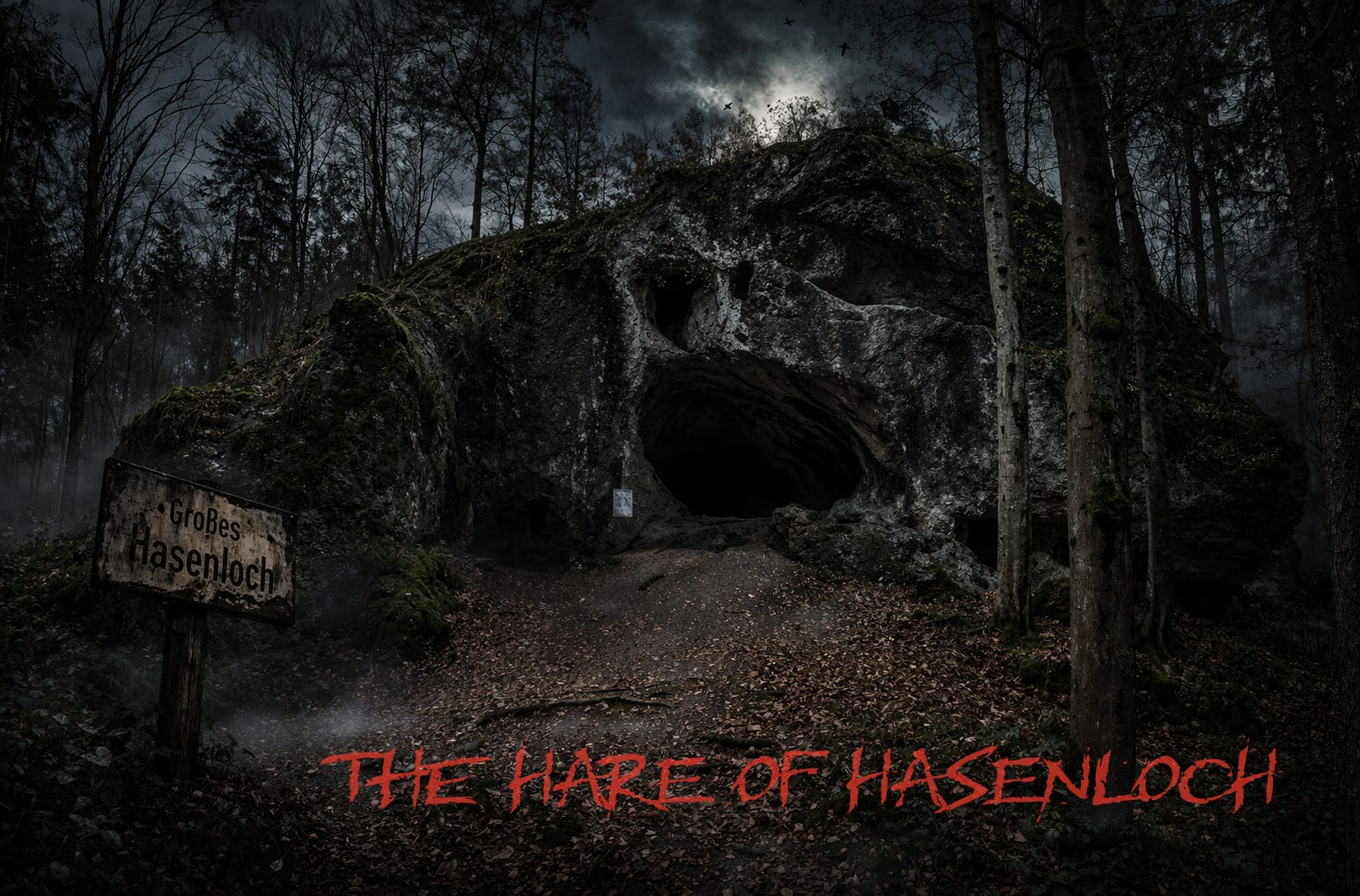
On Sunday mornings in towns like Pottenstein, the bells do more than ring. They gather people in. They call them by habit, by duty, by the old fear of being seen where they ought not to be. The sound rolls over roofs and narrow streets and stone and it settles into your bones so early you stop hearing it after a while. You only notice it when it is missing.
That morning the bells were ringing and three boys were walking the other way.
They slipped out before the service and climbed away from the town, where the houses gave up their hold and the path bent toward the upper Püttlach valley. They were from Pottenstein, all three of them, boys old enough to know better and young enough not to care. Church was for old people, for mothers with folded hands, for fathers with stiff collars and hard faces. The morning outside was brighter. It seemed to promise more.
So they took the promise.
They went into the woods to play.
At first it was only that. The rough sort of game boys play when there are trees enough to hide behind and stones enough to crouch beside. Running and shouting. Chasing and doubling back. One calling out, another vanishing behind a trunk, another laughing so hard he could barely breathe. The woods received all of it and gave nothing back. The sound was swallowed almost at once.
The farther they went, the quieter the day became.
The boys did not notice it at first. They were too busy with themselves, with the thrill of having escaped the town and the church and the eyes of grown people. They were deep in that private kingdom children enter so easily, where a little disobedience feels like freedom and freedom feels like ownership of the whole world.
Then one of them stopped.
The others nearly ran into him.
Not twenty yards away, in a patch of pale light between the trees, sat a hare.
It was white.
Not the dusty white of old bark or limestone. Not mottled, not greyed by earth. Snow-white. So white it seemed wrong in the green shade of the wood. For a moment none of the boys moved.
Then the animal turned its head toward them.
The hare moved first. It bolted and when it did they saw what was wrong with it. One leg dragged behind. It limped badly, awkward and uneven, as if every leap cost it effort.
That changed everything.
A healthy hare would have been gone before they could think. This one looked catchable. Mockable. Easy.
One of the boys laughed.
Then all three of them were after it.
They crashed through brush and over roots, stumbling downhill and then up again, eyes fixed on the bright shape ahead. The white hare never gained much distance. It remained just far enough in front to be seen and followed, its crooked movement drawing them on. Once one of them shouted that he nearly had it. Another swore he could grab it by the hind legs on the next turn.
But the next turn led only to another stretch of wood.
And then another.
And then the game had changed, though none of them said so.
The trees seemed taller there. Closer. The ground stonier. The morning light no longer fell clear and open but in narrow pieces, sliced thin by branches overhead. Their laughter began to sound strange to them. Too loud. Too sharp. It seemed to strike the air and die.
Still they followed.
The white hare remained ahead of them, limping and flashing between the trunks like a scrap of torn cloth. The town was gone behind them. The bells had faded. Even the game they had been playing was forgotten. There was only the animal and the chase.
Then the woods opened onto stone.
The hare ran straight for the hillside and vanished into a dark opening there.
The boys stopped so suddenly they nearly fell over one another.
A cave mouth opened before them.
It was not grand. No jagged maw, no theatrical ruin of rock. Only blackness in stone, a hole in the hillside, wide enough to admit a man bent a little and a child with ease. The white hare was gone inside it.
For a little while the three boys stood where they were.
No one laughed now.
The cave said nothing. The woods had their own sounds before that. A rustle. A bird. The crack of a twig underfoot. Here there was only the stopped feeling of the place, as if the world had paused to listen.
One of the boys took a step back.
Another whispered something the others did not answer.
The third stepped forward. He peered into the dark, glanced once over his shoulder and then went in.
The darkness took him quickly.
First his back. Then his shoulders. Then the pale blur of his shirt. Then nothing.
The other two waited.
Time lengthened. The boys stood at the threshold and stared into the cave mouth as if staring could pull their friend back out.
No sound came.
No joke. No triumphant shout. No cry of surprise.
Only silence.
One of the boys opened his mouth, maybe to call in, maybe to say they should leave and before he could make a sound it came.
The scream.
It rose from inside the cave so suddenly and so miserably that both boys seemed to lose the use of their legs for an instant. It was not long. Not words. Only one burst of sound filled with terror and pain.
Then the silence returned.
The two boys ran.
They stumbled over roots and slid on leaves and struck through brush without caring how the branches whipped their faces. They did not speak. They did not look back. By the time the first roofs of Pottenstein came into sight below them, they were sobbing for breath.
People came out when they heard.
Before the boys had properly got the story out, someone had gone for the missing child’s father.
He did not waste time.
He set out at once with several other men and together they climbed back toward the place the boys had fled from. The children stayed behind while the men entered the woods and followed the way to the cave.
By then the bells had long since fallen silent.
The father reached the dark opening and went in with the others.
What they found lay on the ground inside.
The boy was dead.
Torn to pieces.
Afterward came the understanding people gave it. They said the hare had been no hare at all. They said it had been the Höhlenpöpel, the thing of that cave, which had taken the form of a lame white hare for mockery.
And because stories cling to places, the cave kept the memory of that morning in its name.
Hasenloch.
The Hare’s Hole.
You can tell a story like that quickly if you want. Most people do. Three boys skip church. A white hare appears. One goes into the cave. The others hear screaming. Men return and find the child dead. The creature was the Höhlenpöpel. The cave is named for the hare.
But quick tellings leave out the weight of it. They leave out the bells over the town and the feeling of a Sunday morning opening wide. They leave out the whiteness of the hare among the trees and the silence waiting in the hill.
A scream ends.
A name remains.
Afterword: The Transmitted Version
The story above is a literary retelling. The version below keeps only the shared factual core of the locally published legend.
On a Sunday morning, three boys from Pottenstein skipped church and went into the woods to play. There they saw a snow-white hare that could not run properly. It limped and dragged one leg behind it. The boys stopped their game and chased the hare deeper into the woods until they came to a cave. The hare fled inside. The boys stood fearfully before the entrance and one of them went in. For a while, nothing happened. Then the boys heard miserable screaming from inside the cave. In panic, they ran back and alerted their parents. The father of the missing boy hurried to the cave at once with several other men. There they found the boy lying on the ground, torn to pieces. The hare, the story says, had been the Höhlenpöpel, which had changed itself into a lame hare in mockery. Since then, the cave has been called Hasenloch.
I liked your first version best